Challenges you design, rules the engine enforces
Staff build each challenge in the back office: its phases, its rules and its payout schedule. The rules engine then checks every account on every price, and acts the moment a limit is touched.
The rules
Percentages are of the phase's starting balance unless a rule says otherwise. Equity includes open profit and loss, commission and swaps.
- Daily loss limit
Measured from the balance, the equity, the higher of the two, or the initial balance. The day resets at 00:00 UTC. Profit closed during the day doesn't move the floor until the next reset.
- Maximum loss
Fixed, trailing, or trailing until it reaches the initial balance. A trailing floor follows the highest equity.
- Profit target
Met when the balance reaches the target after costs, with nothing open or pending.
- Minimum trading days
A day counts when its first position opens. A phase can't pass before enough days are counted.
- Trading period
A deadline set from the moment the phase starts. If the target isn't met by then, the phase fails, on time, by timer, whether prices arrive or not.
- Maximum lots per order
An order above the limit is refused.
- Warnings
Warning levels before a limit, for example at 70, 80 and 90 percent of the allowance. Each one is written to the account's journal.
What happens at a breach
- Equity touches a floor. Touching counts: equity at the floor is a breach, one cent above is not.
- The account locks at once. Pending orders are cancelled and requests in flight are refused.
- Open positions close at the accepted price.
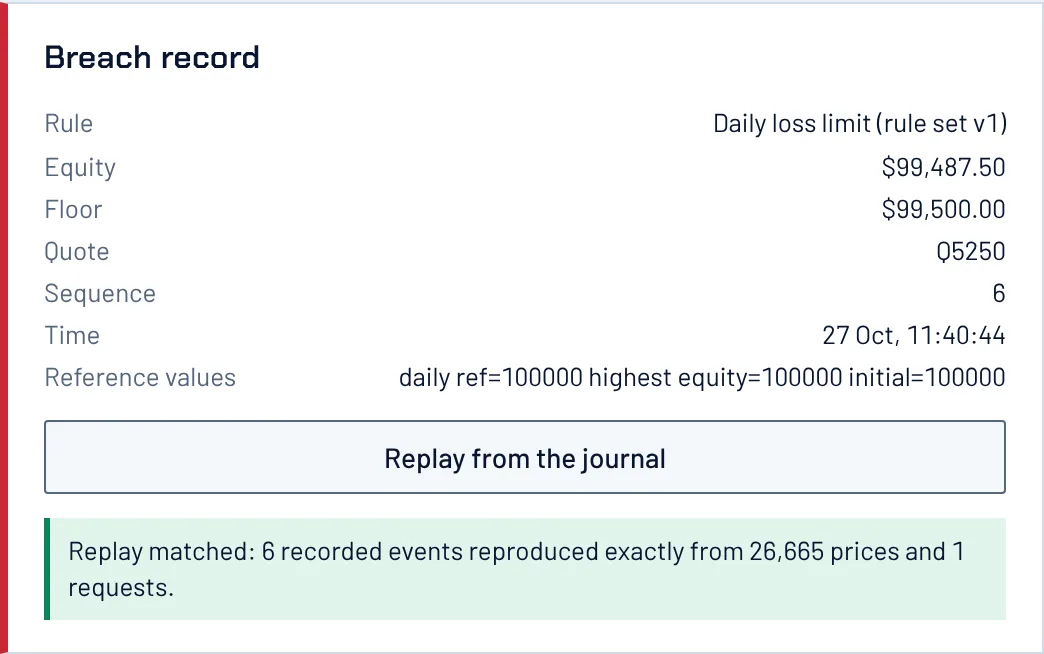
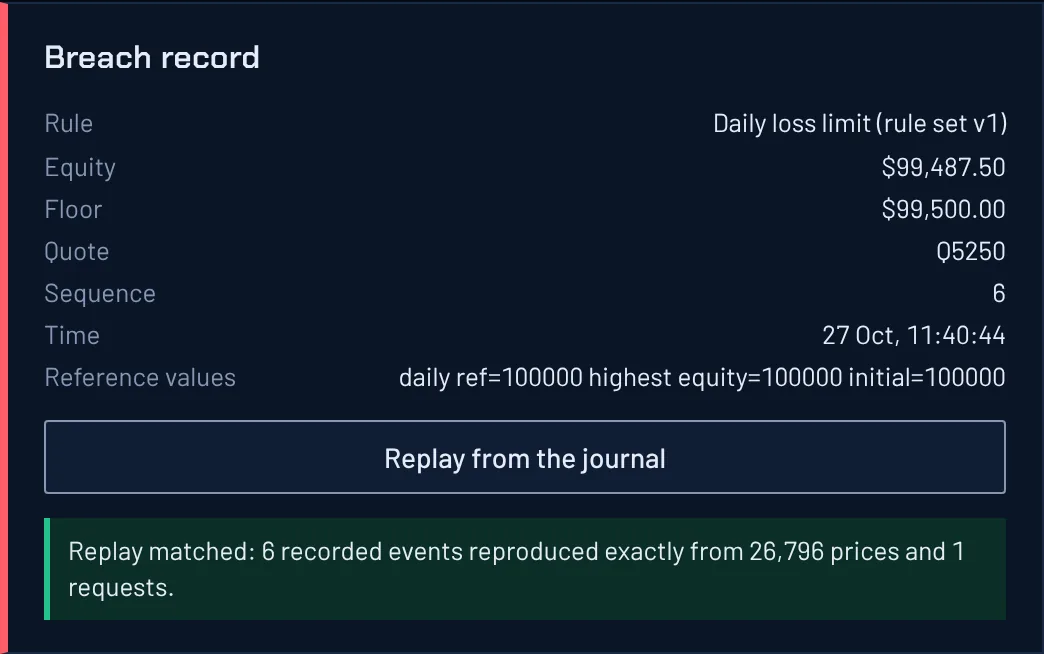
- The breach record is written: the rule, the rule-set version, the equity, the floor, the price ID and the sequence number.
The challenge builder
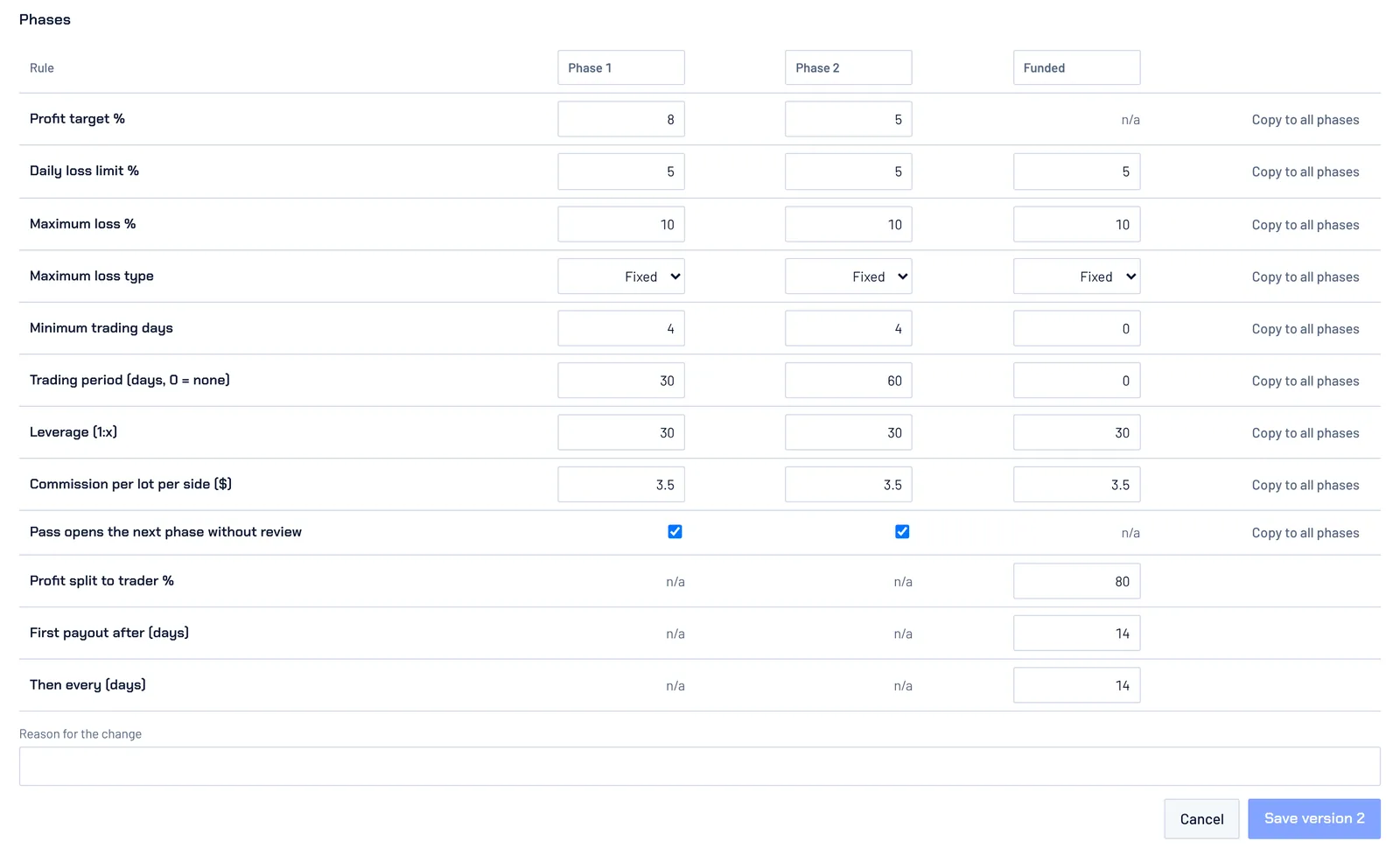
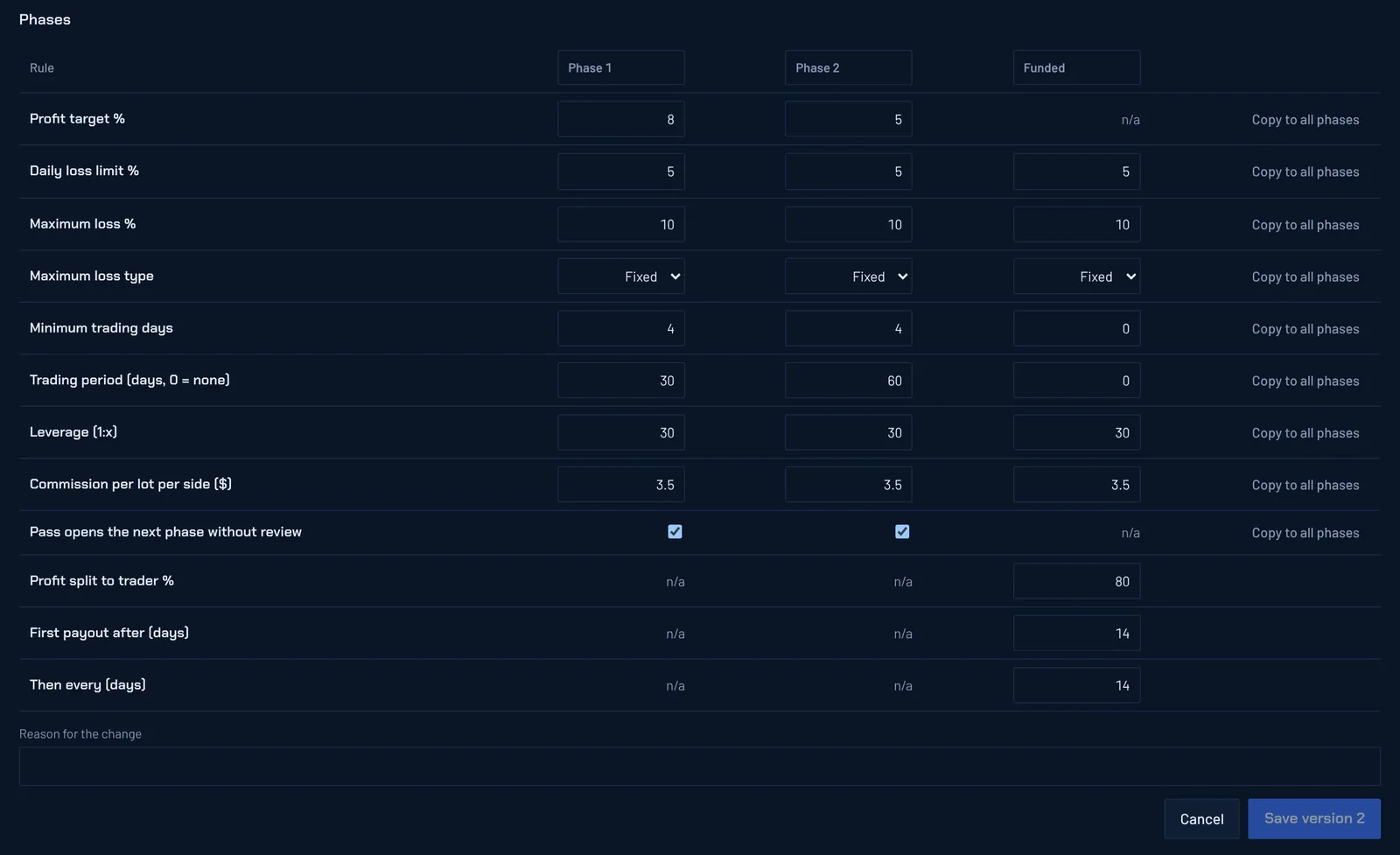
Everything about a challenge is set in one editor in the back office.
- Phases
Up to seven phases, the last one funded, with a profit split. Each phase has its own rules, leverage and commission.
- Passing a phase
A pass can open the next phase automatically, or wait for a staff member to review it.
- Payout schedule
The first payout after a set number of days, then every set number of days after that.
- Account sizes
Several account sizes per challenge, each priced on its own.
- Identity checks
Each challenge says where an approved identity check is needed: before buying it, before the funded account opens, before a payout, or not at all.
- Copying
Each challenge says whether its accounts can copy trades: not at all, only between the trader's own accounts, or from public strategies too.
- Add-ons
Optional extras bought at checkout can change one setting of the challenge they are bought with, such as the profit split or the payout schedule. More on add-ons
- Versions
Every saved change creates a new version, and each change needs a reason. A version never changes once it has been sold: accounts keep the rules they were bought with.